Roof Condition Reports in Greenville, TX
A hail bruise photographed with a quarter beside it ends most arguments. The dent is there, the size is plain, and the date is stamped in the corner. That is what a good roof report is made of.
A roof condition report in Greenville, TX is a written record of what we found on the roof, where, and what to do about it. Photos tied to a roof map. A rating for every section. A price for fixing it now and a price for waiting.
Owners use it to budget. Lenders use it to underwrite. Adjusters use it to settle. One walk, one document, and nobody has to take our word for it.
What is on every page of the report?
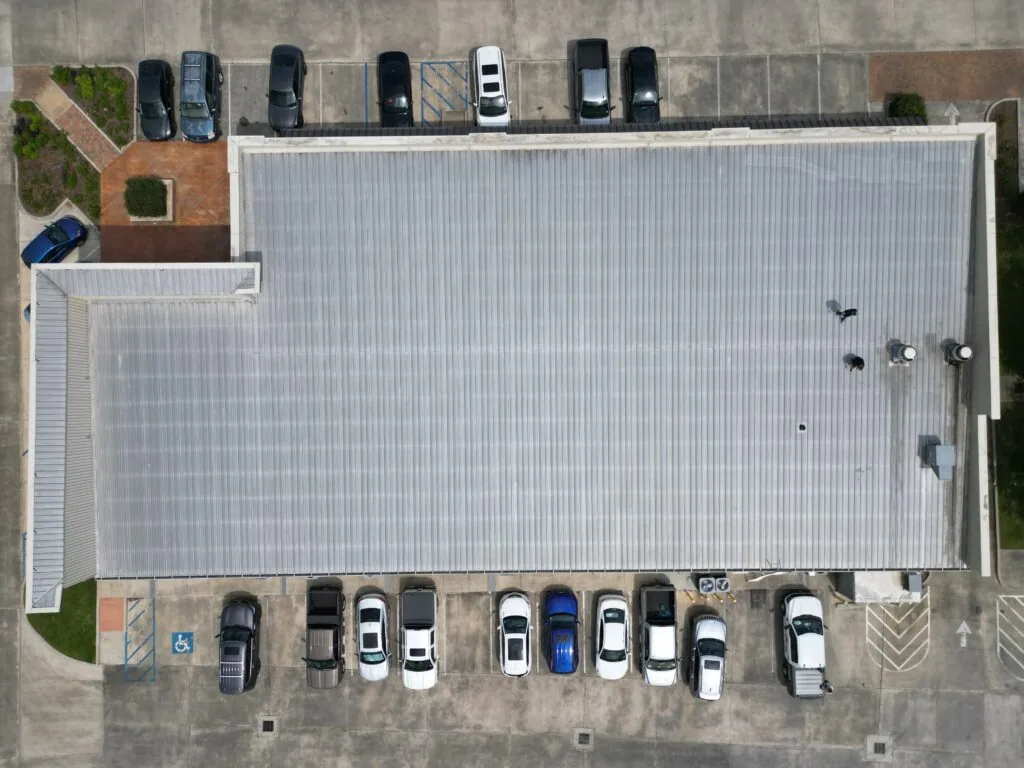
A roof map first. Each section, curb, drain and unit is numbered so the photos make sense without anyone standing next to you. Then the findings, in the order the crew walked them.
Each finding carries four things:
- A photo with the date and a scale reference
- A plain sentence on what it is
- A rating: fix now, fix this season, or watch
- A repair scope that a crew could price from
We also record the system, the apparent age, the deck type where we can see it, and the state of the insulation and drainage. Where we ran a core or a moisture scan, the results sit beside the photos they explain.
No chart for the sake of a chart. If a number does not change what you do next, it stays out.
How do findings turn into priorities?
By consequence and by cost. A failing wall base flashing over an occupied office outranks a crazed coating on a storage roof. A split lap that is wet underneath outranks one that is still dry.
Every roof section gets a bottom line: repair, restore, recover or replace. We show the repair price and the replacement price together. If a repair is only a few months of life, the report says so in plain words.
We do not pad the list. A roof that is sound gets a clean page and a note on when to look again. Owners trust a report more when it says a roof is fine.
Those grades become the baseline for a yearly roof asset management record, updated each time the crew walks the roof again.
Who reads a roof report, and what do they want from it?
Owners want a plan and a price. Lenders want age, condition and remaining life. Buyers want the surprises before closing. Adjusters want proof of what the storm did and what was already there.
A general contractor wants something different again: a scope that does not shift once the crew opens the roof. A report with core results and photos of the deck gives the bidders the same facts, so the bids can be compared line by line.
Insurance claims get their own care. Dated photos of hail marks, wind lift and torn flashing, tied to the roof map, back up the claim. The report is the first document in the file when claim assistance starts, because every later request points back to it.
For an acquisition or a refinance we write a tighter version, the kind a buyer or lender reads in a due diligence roof survey.
What does a report cost, and how long does it take?
The price follows roof area, access and testing. A small flat roof is a short visit. A plant roof with dozens of units, two levels and years of patches takes a crew a full day or more.
Add-ons change the price. A drone flight speeds the survey on a large roof and gets photos of areas that are unsafe to walk. An infrared scan adds the wet-insulation map. Cores add a few hours and a few repair patches.
Turnaround is days, not weeks, on most buildings. When a sale or a loan is on a clock, tell us the date. We schedule the walk first and write while the paperwork moves.
What does a Greenville report keep an eye on?
Hail first. North Texas spring storms can bring stones up to softball size, and the June 2019 Greenville storm brought 85 mph wind and baseball-sized hail. The roof of a church sanctuary on Joe Ramsey Boulevard was badly damaged in it. We look for bruising on every flat roof we walk.
Downtown has its own list. The older masonry commercial buildings along Lee Street and Washington Street, around the 1929 Hunt County Courthouse, get a different walk. On a building that age we spend more pages on parapets, copings and drains than on the open field.
Hunt Regional Medical Center is on Joe Ramsey Boulevard and began a two-story expansion in 2021. Confirm current access and work windows with the facility contact before proposing a roof schedule. A report on a campus like that writes the timing into the scope. Medical office roofs get the same care: walks timed around patient hours and quiet space.
Summer heat gets a section too. DFW weather records include extended runs of triple-digit July heat. Inspect sealants, flashing terminations and laps at each industrial roof in Park West or the Orbis plant on Shelby Avenue before recommending maintenance.
How does the walk fit around the building?
We come with a small crew, a camera and a probe, and we agree on a route before we go up. The roof access, the hatch key and the alarm are sorted ahead of time. The crew stays off tenant space and leaves the roof the way it was.
On a building in downtown Greenville we settle the access route and the foot traffic below before anyone climbs. Industrial roofs need a safety briefing with the plant. Either way, the walk is quiet and quick, and the report follows. Owners with buildings in Bonham and Commerce can use the same photo labels and repair priorities to compare separate roofs without mixing their records.
Commercial Roofing Questions
Will a report from a roofing contractor hold up with a lender?
It holds up when it is specific. Lenders want a roof age, a stated condition, remaining life and a repair or replacement estimate, each backed by photos. We write to that list. If your lender sends its own template, send it and we will fill it in.
We do not hide bad news. A report that skips problems costs you later.
Is a walk-the-roof report better than a drone report?
Neither replaces the other. The drone covers a big roof fast and finds ponding, staining and loose edges from above. Hands on the membrane find the soft spots, the lifted laps and the bruises a camera misses.
On big roofs we fly first, then walk the areas the photos flagged. That gives you the full picture in less time.
How soon after hail should we order one?
Within days, if you can. Fresh bruises are easy to tell from wear. A few weeks of summer heat and rain smooth them into the background, and an adjuster will point to age when they dispute the claim.
Do not patch before we photograph. Patches cover the evidence.
What if the report finds nothing wrong with the roof?
Then you hold a clean record, and that has value. It tells a buyer the roof was walked, it tells your insurance carrier what the roof looked like before the next storm, and it sets the starting point for the next report.
We note when to look again, usually after the next storm season.
Do I get the photos or only the write-up?
Both. The full-resolution photos come with the report, labeled to the roof map. You may need them years later, for a claim or a sale, and they should not be locked in a vendor system.
Keep them with the building file, next to the warranty papers.