EPDM Roofing in Greenville, TX
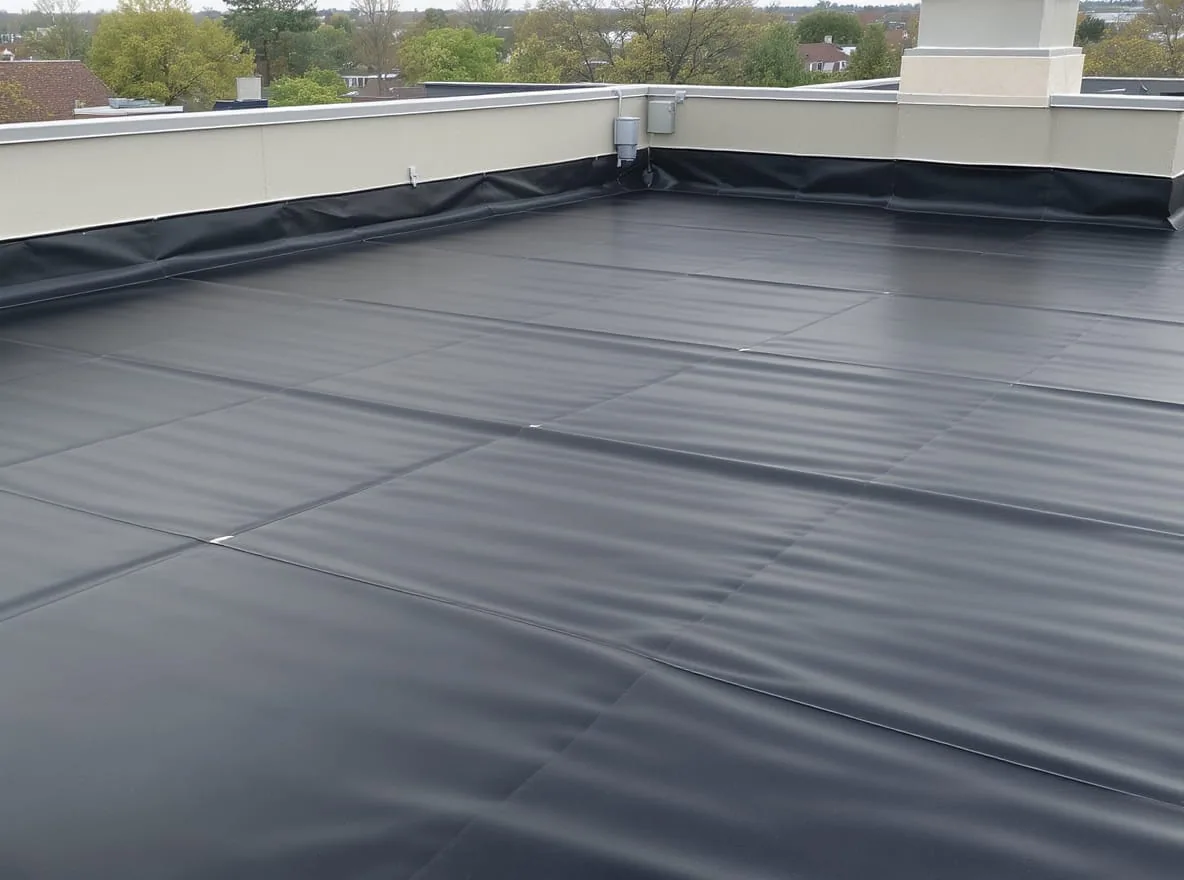
Old EPDM shrinks, and you see it first at the walls. The black rubber pulls tight, stands off the flashing like a bowstring and leaves a gap where water goes in. The field of the roof can look fine from a ladder. The leak is at the edge. That is the pattern we find on most aging rubber roofs, and it tells us what the repair will cost before we open a seam.
EPDM is ethylene propylene diene monomer, a synthetic rubber sheet that has covered flat roofs for a long time. In Greenville, TX it turns up on small flat roofs, on flat sections of larger buildings and on ballasted roofs. This is how it holds up under North Texas sun and storms, how it gets repaired and when it is time to replace it.
Why does old EPDM pull away from the wall?
Because rubber loses plasticity in the sun and contracts as it ages. A sheet that was relaxed when it went down gets tighter every summer, and the first thing to give is the base flashing at parapets, curbs and equipment pads. The membrane lifts, the sealant lets go and water finds the gap.
You can feel it. Press along a wall base and the sheet either sits flat or bridges the corner like a drum skin. A bridged corner is a leak waiting for the next heavy rain.
We fix this by cutting back the tight sheet, adding new flashing and re-securing it with adhesive and termination bar. If the shrinkage runs the full length of the roof, we price a replacement alongside the repair so you can see both. A flashing failure repair buys time, not a new roof.
What do the splices tell us about the roof?
Plenty. EPDM seams are joined with splice tape or liquid adhesive, and they are the second weak point after the walls. Look for lifted edges, dirt lines along the lap and fishmouths where the top sheet has curled up.
A well-made splice outlasts the sheet around it. A splice made on a dusty, damp or cold day is the one that opens first. When we see a run of failed seams, it usually traces back to how the roof was installed, not to weather alone.
We clean and prime every repair surface, then apply new tape or a patch and roll it down. Plastic cement over a split seam is a stopgap that dries out and cracks. Fix the seam, not the stain.
Ballasted, adhered or fastened: which EPDM fits my building?
Ballasted roofs hold the sheet down with loose stone or pavers. They are simple and forgiving, and they are heavy. Adhered roofs glue the sheet to the insulation and resist wind better. Mechanically fastened roofs use plates and screws, and they sit in the middle on cost.
Wind decides a lot here. Greenville’s June 2019 storm included straight-line winds near 85 mph. After high wind, inspect ballast distribution and exposed membrane at the specific property. Stone that blows off exposes the sheet and, in a bad case, strikes people and cars below.
On an existing ballasted roof we check the stone depth, the edge metal and the perimeter. If the building cannot take the weight, we switch to an adhered or fastened system. Every route has a price tag, and we put them side by side.
How does EPDM hold up to hail and a long Texas summer?
Better than many owners expect. EPDM’s response to hail depends on the membrane, insulation, attachment and stone size; inspect the installed assembly before choosing a repair. Big stones still bruise, and a hit over a soft board punches through.
Heat is the long game. Black membrane absorbs more sun, and summer afternoons here push roof surfaces well past air temperature. The sheet ages by drying out and shrinking, which sends us back to the walls. Greenville has long, very hot summers. Inspect the membrane, seams and wall terminations for stress, then compare observed condition with the specified assembly. Factor documented heat exposure into the system review and inspect membrane condition directly.
When heat is the main complaint, a white-faced sheet or a coating is worth a look. A sheet worn down by heat and UV damage can often be extended with either one.
What does an EPDM repair or re-roof cost?
Repairs are priced by scope. Count the seams, walls, boots and penetrations that need work, then add access and how many visits it takes. A roof with ten defects in one corner costs less than ten spread across the building.
A full replacement turns on the old roof. Ballast has to be swept off and hauled. Adhered systems need a clean, dry substrate. If insulation is wet, it comes out. A replacement with new tapered insulation and drains costs more than a recover and is often the right call on an old, ponding roof.
Timing depends on the weather window. Rubber installs in dry conditions, and adhesive wants a surface that is dry and not too cold. We schedule around spring storms.
Where does EPDM still make sense around Greenville?
On smaller flat sections, older masonry buildings and low-traffic roofs. Where an older masonry building along Lee Street and Washington Street in Downtown Greenville has a flat roof behind a parapet, rubber is easy to detail around old walls and drains.
Campus buildings are another fit. East Texas A&M University in Commerce drives campus roofing demand, and where a campus building has a small flat roof, EPDM is easy to patch in sections between semesters. The same sectioned approach carries over to larger campus roofs.
For a large industrial roof in Park West Industrial Park, compare EPDM with TPO or PVC against slope, attachment, drainage and reflectivity needs. We price EPDM alongside those options when a roof is small, cut up or full of penetrations. Carlisle is one of several makers whose EPDM systems we install.
Commercial Roofing Questions
Why does my EPDM roof leak at the wall when the field looks fine?
Check the wall base first. Aged rubber shrinks, and the sheet pulls away from the flashing, so the leak starts where the field meets the wall. We find open termination bar, dried-out sealant and gaps behind the membrane. The fix is new flashing and a reattached edge, and it usually costs far less than replacing the whole roof. If the shrinkage is everywhere, plan the budget for a replacement.
Is black EPDM too hot for a Texas roof?
It runs hotter than a white sheet, and the building pays for that in cooling load. Black rubber still lasts when it is well installed and kept clean, and it is easy to repair. White-faced EPDM is made for owners who want the rubber benefits with less heat gain. We compare the options against your utility bills and the roof use.
Can I coat over an EPDM roof instead of replacing it?
Sometimes, but only after a clean test patch. EPDM needs the right primer and coating chemistry, and a coat over a chalky or shrinking sheet will not fix wall leaks. Coating works best on a sound, dry roof that mainly needs reflectivity and sealing. We scan and test before we recommend it, and we show you silicone and acrylic options in writing.
How do I know if my ballast is a problem?
Loose stone and bare spots are the tell. Look at the corners and edges, where wind lifts first, and at the drains where stone washes down and clogs. If the ballast has thinned or the edge metal is loose, a wind event can strip it. We inspect and rake it back, then add stone or switch to an adhered system when the building cannot carry more weight.
Should I replace EPDM with TPO when it fails?
Match the new sheet to the building, not to the old roof. TPO is a common choice when the owner wants a white, welded roof and faster installation. EPDM is still a good call on small, cut-up roofs. We price both, along with the insulation and drainage changes, and give you the numbers side by side.