Heat and UV Roof Damage Repair in Greenville, TX
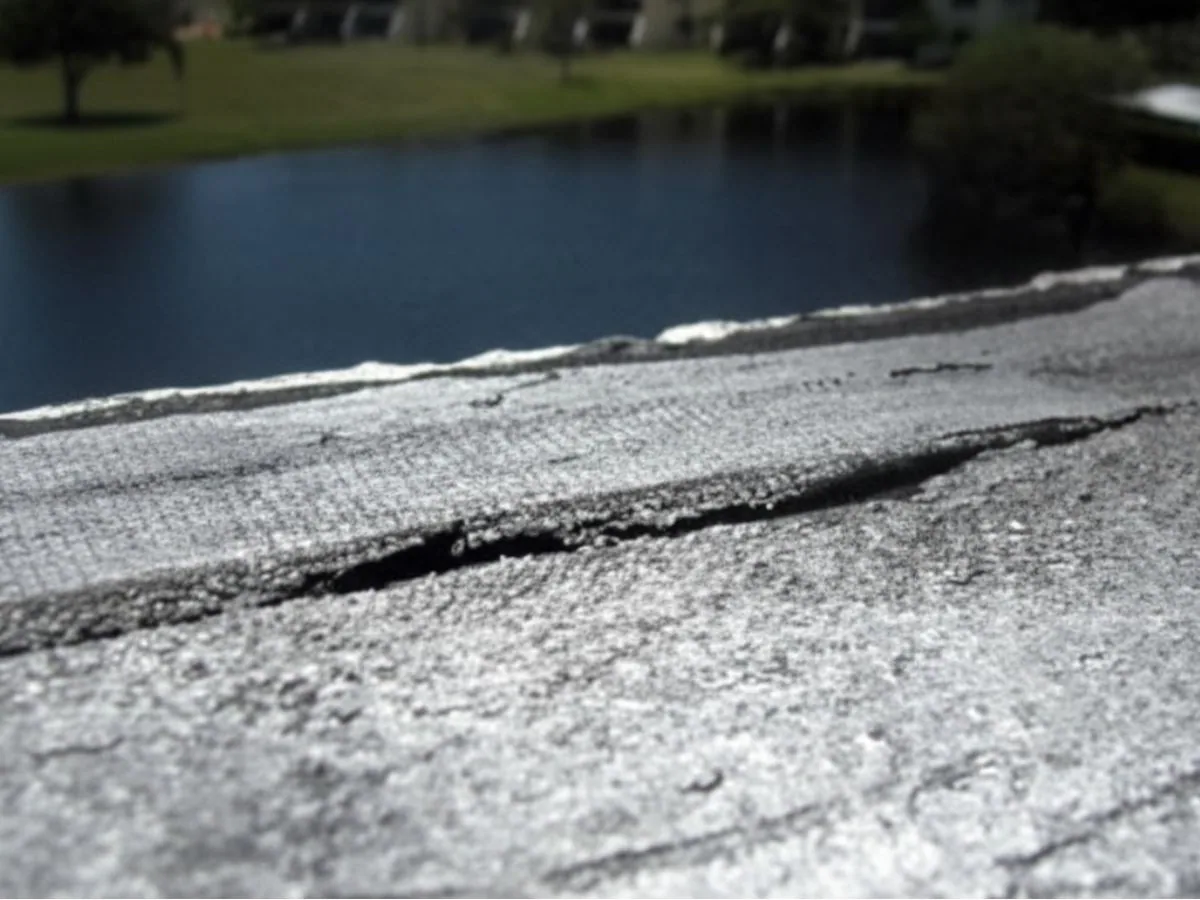
A split lap can result from aging, movement or installation conditions; inspect the seam and substrate before identifying the cause. Sun exposure can dry, shrink and split a seam without a storm report.
On a big flat roof in Greenville, TX, the damage builds one hundred-degree afternoon at a time. A ceiling stain in August may be the first indoor sign.
How do I tell sun damage from storm damage?
Sun damage spreads across exposed areas; wind lifts edges and hail leaves scattered bruises. Heat is strongest on the open slopes.
When we get on the roof, we look for a short list of signs:
- Fine cracks across the surface of a single-ply sheet or a coating
- Laps that have opened or gone stiff, with a gap a probe slips into
- Bare mat showing where granules washed off a cap sheet
- Sealant at flashings and penetrations that has shrunk or pulled off the metal
If the marks are scattered and soft under a thumb, that is hail damage, and the paperwork runs a different way.
What does a Greenville summer do to each kind of roof?
The Dallas-Fort Worth weather record for July holds 31 days at 100 degrees or hotter in 1980, with 27 such days in 2022. A flat roof runs far hotter than the air above it. The membrane sees more heat than any thermometer in town reports, and dark surfaces take the worst of it.
Each system ages its own way. A TPO sheet loses flexibility at the surface, and the welds carry the strain, which is the story behind TPO roofing that cracks along a seam edge. PVC can stiffen as it gives up plasticizer. EPDM shrinks and pulls at the flashings. Modified bitumen and built-up roofs shed surfacing, and the asphalt underneath oxidizes and turns brittle. Metal panels move every day, which loosens fasteners and works the sealant at each lap.
Ultraviolet light runs a second clock beside the heat. It breaks down the top layer of the sheet, the coatings and the sealants. Once that layer is gone, the reinforcing scrim is exposed, and scrim is what holds a single-ply sheet together.
Why do the edges and flashings fail before the field?
They move the most. A field sheet is held down by adhesive, ballast or fasteners over a large area. A wall flashing hangs from a termination bar and a bead of sealant. The roof swells in the afternoon and tightens overnight, and every cycle tugs on that bead. After enough summers the sealant lets go and the flashing sags.
The bigger the building, the more parapet and curb flashing it carries, and the Park West Industrial Park holds plants as big as the 315,000 square foot Brakebush Brothers facility. Every foot of flashing is a place where shrinkage can open a gap.
We cut out the failed sealant, clean the substrate, re-fasten the termination and tie new flashing into the sound sheet. A proper flashing repair is cheap next to the wet insulation a loose wall detail lets in.
Does a spring storm make the summer worse?
It does. Hail and wind strip the protective surface, and the heat then works on bare material for the rest of the season. Straight-line wind near 85 mph and big hail came through town in June 2019, and one roof in downtown Greenville fell in.
A bruise in April is a crack by August. Catching the first costs a patch. Catching the second costs a section.
What does the repair cost and what moves the number?
The price follows the scope. A few failed laps and flashings is one job. A surface that has crazed across a whole slope is another.
These things push the number:
- How much roof area is affected
- Whether the insulation under the damage is wet
- Length of wall flashing, and the count of curbs and penetrations
Wet insulation is the big swing. A heat crack left open through a few storms feeds water into the insulation, and wet insulation means tear-off of that section plus a new dry-in. We run an infrared moisture survey before pricing anything bigger than a spot repair. It shows where the water sits, so we cut out only what is wet.
Should I repair, coat or replace?
It comes down to how much good sheet is left. We press on the membrane, pull a core or two and measure what remains of the surface layer and the scrim.
Three paths cover most roofs:
- Repair, when the damage is local and the insulation is dry
- Coat, when the sheet is still tight, the seams are bonded and the deck is sound
- Replace, when the field is brittle, scrim shows through, or cores come up wet
A reflective roof coating and restoration system can slow the next summer of aging and keeps the roof out of the landfill. When the sheet is past saving, a commercial roof replacement is the right answer.
How does the work run on a building that stays open?
Heat repair is mostly small work by a small crew, so mobilization stays light. Crews stage on the ground, hoist materials, tie new material into the sound sheet and walk a punch list at the end of each day. By early afternoon a roof surface can be too hot to weld or to stand on, so the crew starts at first light.
Around the I-30 and Joe Ramsey commercial corridor, roof work near occupied surgical and women’s services areas is coordinated with facility staff around the affected spaces. L3Harris performs aircraft modification work at Majors Field. Confirm site access and delivery requirements with the property contact before mobilization.
If a heat crack has already let water inside, call at any hour. Emergency response runs around the clock, holidays included. A spring and fall preventive maintenance walk catches most of this before it leaks. On buildings in Commerce and Sulphur Springs, compare exposed membrane and flashing conditions after hot periods instead of assuming every roof ages at the same pace.
Commercial Roofing Questions
The white surface on our warehouse roof has gone dull and grey after a few summers. Is that damage?
Dull and grey is usually dirt and light surface wear, and it is not damage by itself. Wash a test square and see what is left. If the white comes back, the roof only needs cleaning. If the surface looks crazed or the weld edges feel stiff, get a crew up there to probe the seams and pull a core.
Will insurance pay for sun damage?
Most policies treat wear and aging as maintenance, and a storm as a covered event. That means a sun-split lap is usually yours to fix, while hail or wind damage may be claimable. Read your policy before you assume either way. Where the damage is mixed, our photos and written condition record show which marks came from the storm and which came from the summer.
How many hundred-degree days does it take before a roof starts to fail?
No single number fits every roof. Age, color, slope, drainage and the original sheet all change the answer. A white membrane that drains well can take a hard summer with little change, while a dark roof that ponds can show wear much sooner. After a long run of triple-digit days, like the 27 DFW logged in July 2022, walk every older roof in September, while a weather window remains.
Should I coat a sun-baked roof now or wait until the next budget year?
Coat now if the cores come up dry and the seams are still bonded. Waiting a year gives water a year to find a crack. If the cores come up wet, coating is the wrong spend, and the money belongs in the wet section. We show you the cores and both numbers so the budget has real figures behind it.
Why did a leak show up in August on a roof that held through the spring storms?
Because the spring storms were probably not the cause. A hot summer opens a lap or pulls a flashing off a wall, and the next afternoon thunderstorm finds the gap. We trace the leak to the opening, repair the failed detail and check the insulation around it. If it is the first of many, we say so and mark where the next ones are likely.