Flashing Failure Repair in Greenville, TX
Black mastic has cracked open along the wall base, and a pencil slides in behind it. The field of the roof can be perfect and the building still leaks right there.
Flashing is the part of the roof that meets everything else: walls, curbs, pipes, drains and edges. It moves every day and it fails first. Flashing failure repair in Greenville, TX is mostly hand work on a roof you have to walk slowly. We find every open joint, pull the bad material back to sound substrate and rebuild it right. A leak call is almost always a flashing call, and the fix costs less than the ceiling tile.
Where does flashing let go first?
At the places that move. Wall bases open where the roof and the wall expand at different rates. Penetration boots split where a pipe flexes. Curb corners tear where the sheet was folded instead of formed. Edge metal lifts where the sealant dried out.
We look for signs a thumb can find. Cracked or pulled-back sealant. Bridged membrane at an inside corner. Open end laps in counterflashing. Rusted fasteners. Base flashing that has slid down the wall. A pitch pocket gone hard and dished. A rubber boot that went brittle in the sun. Loose coping and edge metal belongs on that list too.
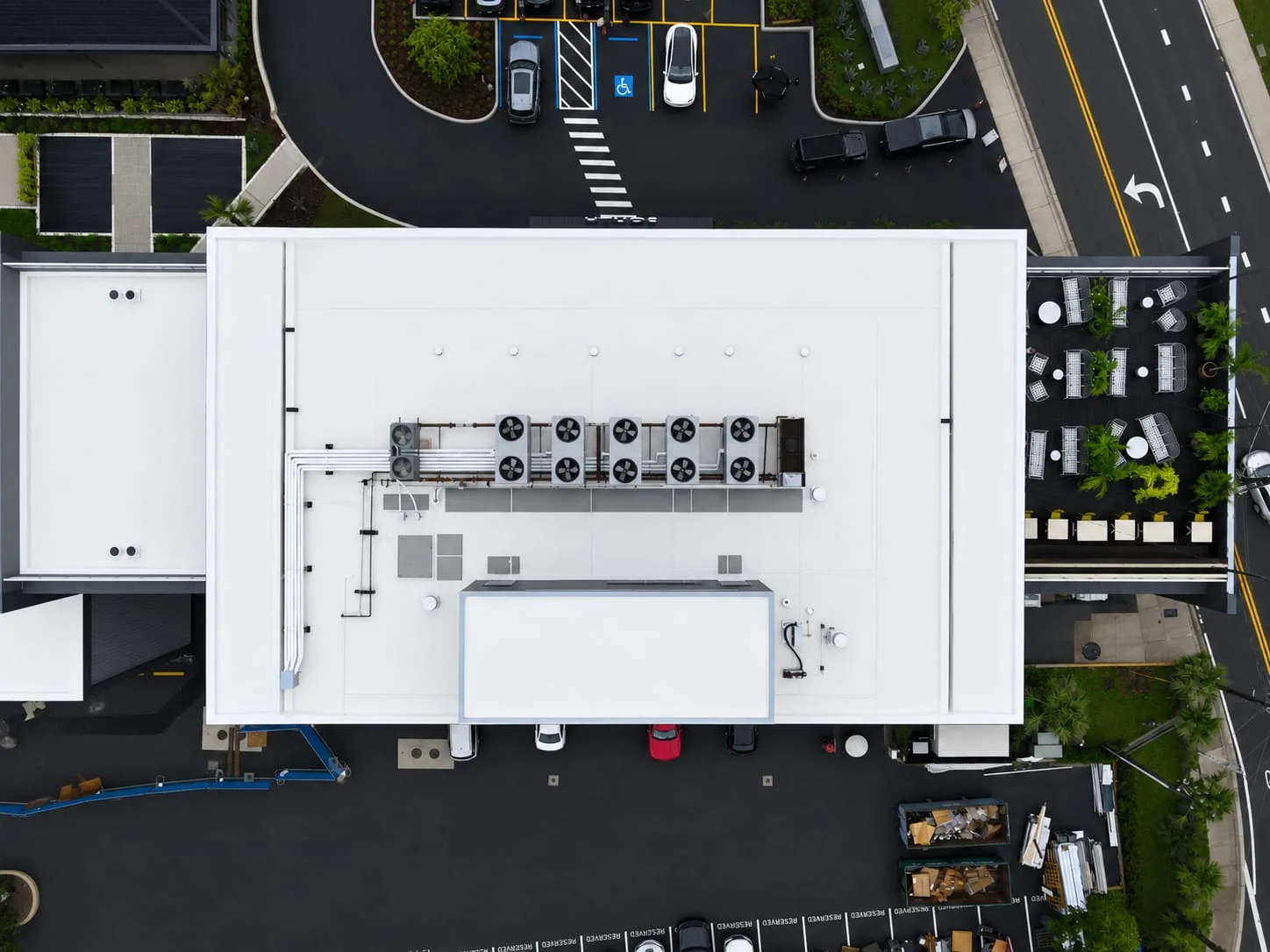
Every one of those is a small opening, and water does not care how small. The pipes and units that cause most of the trouble sit on rooftop equipment curbs and supports, and each one is its own flashing detail.
Why does a wall base fail when the field is fine?
The field sheet is loose and the wall base is trapped. The field can shift and breathe. A membrane glued up a wall and capped with metal cannot, so every temperature swing pulls on the one place that has no give.
Add shrinkage. Membranes pull back with age, and the base flashing drops away from the top of the wall or tears out of the corner. Add details left over from the original install: no cant strip, thin terminations, counterflashing set into mortar joints that have since cracked. On older masonry buildings like those in downtown Greenville, the mortar joints behind the counterflashing can open up and let water in behind the metal.
So the leak shows up inside a wall or a ceiling corner, far from the actual opening. We trace it from the wet spot back to the entry point before we replace a single foot.
Can you caulk it, or does it have to be rebuilt?
Caulk is a short answer for a hairline crack. That is all. Sealant on a joint that keeps moving will crack again, often inside one season.
A real repair pulls out the failed material and goes back to a clean base. We cut the old flashing back until the substrate is sound and dry. The new flashing goes in with the right membrane for the system, a proper cant at the corner, a termination bar fastened through and sealed on top, and counterflashing reset so water runs over it and not behind it. On a skylight or penetration that often means a new curb kit or a prefabricated boot, not another tube of sealant.
Sometimes the better call is to redo the whole run. If half the wall base on a building is open, patching it joint by joint costs more in the end than doing it once. We price both and put the numbers side by side.
What does a Texas summer do to flashing?
Flashing takes the heat first. The roof surface and the metal up the wall run far hotter than the air. Use the inspected sealant bond, metal movement and attachment condition after hot-weather exposure to set the repair scope. On the roof, inspect sealant flexibility, metal movement and adhesive condition before choosing a repair. Then the night cools it and everything pulls back.
Park West includes a Brakebush Brothers food-processing facility reported at 315,000 square feet. Count roof penetrations on site; each stack, fan or pipe needs its own flashing check. The June 2019 Greenville storm collapsed a roof and damaged a facade at a Lee Street building. The storm path also ran through Campbell; after hail, inspect the wall base and penetrations at each affected building.
Additions are the other trouble spot. Where a new section joins an old one, the tie-in wall is a flashing detail between two roofs that move differently. Hunt Regional Medical Center broke ground in 2021 on a two-story expansion, and wherever new work meets existing building in the I-30 and Joe Ramsey commercial corridor, that joint goes on the list for every walk.
What does flashing repair cost and how long does it take?
Price follows the linear feet and the number of details. One pipe boot is a short visit. A full wall base with new counterflashing is days of hand work. Hand work is slow. That is why flashing costs more per foot than field membrane, and why a low bid usually leaves details out.
Timing is a dry day. Flashing adhesives and sealants need clean, dry surfaces and mild temperatures, so we plan around the forecast. For an active leak we dry in first, then rebuild in a good window. If a pond is sitting against the wall, fix the water first. Ponding water repair comes before new flashing, or the new flashing ends up underwater.
An active leak gets traced and dried in through commercial roof leak repair before any flashing is rebuilt. Drainage should be checked alongside flashing, especially where the inspection also finds ponding water.
Commercial Roofing Questions
How do I know a leak is flashing and not the membrane?
Look at where the water shows up. Leaks near a wall, a curb, a pipe or an edge point to flashing. Leaks in the middle of an open field with no penetration nearby point to the sheet. We confirm with a water test on the suspect detail, one area at a time, so we repair the real entry point and not just the nearest one.
The mechanical contractor set new units and the roof started leaking. What now?
Common story. Trades cut and cap penetrations, and the roofer is not always called back to flash them. We document what was done, mark what is wrong and rebuild the details to a standard that holds. Who pays is a contract question between you and the trades. We give you the photos and the scope so that conversation has facts in it.
Will new flashing match the old roof membrane?
It has to be compatible, not identical. Flashing is a different product from field sheet in many systems, so the new material will look different. What matters is the weld or bond to the existing sheet and the termination at the top. If the old membrane is too aged to bond to, we cut back to sound material first.
How often does flashing need to be resealed?
There is no set date. Sealant on a joint that moves a lot may need attention within a few years, while a well-built metal and membrane detail can go much longer. A planned walk each spring and after each major storm catches open joints while they are still cheap. We log every detail by location so you can see what has changed.
Does wall flashing repair need the wall fixed first?
Sometimes. Flashing needs something solid to seal to. Spalled masonry, cracked stucco or loose coping stone will not hold a termination, so the wall gets repaired before the flashing goes on. We flag it in the scope and coordinate with your mason if you have one, so the schedule does not stall.