KEE Roofing in Greenville, TX
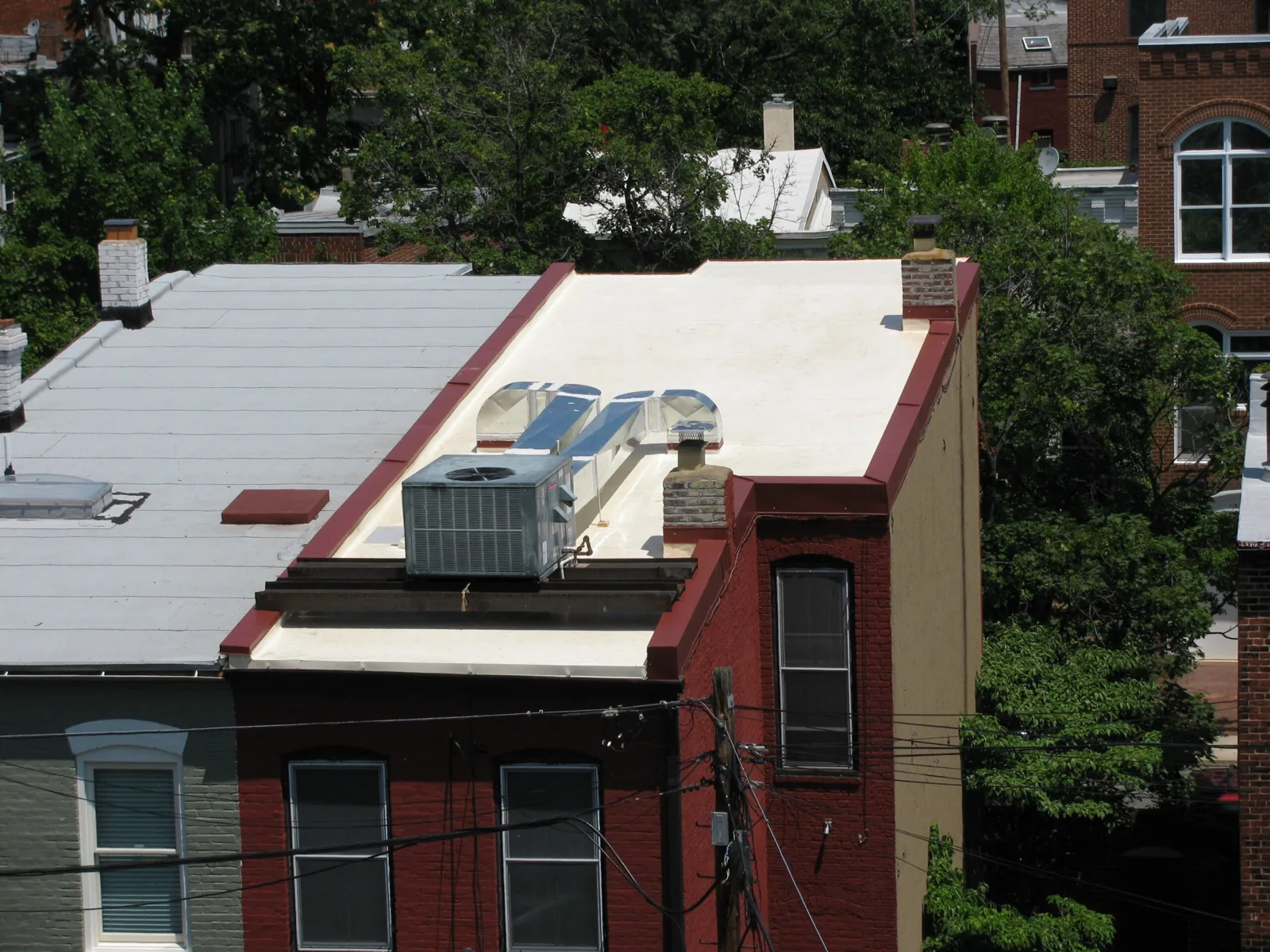
A KEE roof under an exhaust stack stays supple long after its neighbors have gone stiff. Walk a plant roof and you can find the line: dull, hardened sheet on one side, soft and still flexible on the other. That difference is the case for KEE, and it is also the reason this membrane is used so rarely. It earns its place on a short list of roofs.
KEE stands for ketone ethylene ester. It is a PVC-alloy single-ply membrane, heat welded like PVC and built to take oils, solvents and chemical vapor that wear down ordinary sheets. In Greenville, TX the question is whether your building is one of those roofs. Here is how we sort it out, what the install looks like and what it costs to be wrong.
What is in a KEE sheet that plain PVC does not have?
A different softener. Standard PVC stays flexible with plasticizers that can migrate out over time, especially when a roof is hot or soaked in chemicals. KEE blends a polymer that stays put, so the sheet holds its flexibility and its welds longer under harsh exposure.
The practical result is a membrane that tolerates grease, animal fat, many oils and a wider range of airborne chemicals. It still welds with hot air, so seams fuse into one sheet. It still reflects heat when it is white.
None of that makes it magic. A KEE roof can be punctured, can pond water and can be installed badly. It simply gives the roof a better chance in a rough environment.
Which Greenville roofs belong on the KEE list?
Plants with a process under the roof. Orbis has roughly 420,000 square feet of injection-molding space in Greenville. Inspect exhaust points and nearby roof details before choosing a membrane. Fritz Industries makes oilfield drilling, cementing and stimulation products in Greenville. Verify membrane compatibility against the exhaust conditions found at the property. Roofs over that kind of process are where a KEE sheet is worth pricing.
Food processors come next. Chicken processing, like the 315,000 square foot Brakebush Brothers facility in the Park West Industrial Park along SH 380, can send fat and moisture up through the exhaust. The membrane has to survive that spray year after year, and a manufacturing plant roof should be chosen on that load.
Dry warehouses and office buildings do not need it. If the roof sees weather and nothing else, a plain white sheet does the job for less. We tell you that up front.
How does a KEE roof go down on an occupied plant?
In sections, with the building kept dry. The crew strips an area, checks the deck, lays insulation and cover board, and rolls out the membrane. Seams get welded, probed and flashed before the section is called done. By evening the section is dried in and nothing is left open.
Attachment is mechanical or fully adhered. Mechanically fastened sheet goes down faster, and an adhered system gives you a smoother surface and less flutter in wind. On a plant, the choice usually follows the deck and the wind uplift rating that the insulation can carry.
The harder part is coordination. Forklifts, hot work, trucks and shift changes all run under the roof, and the crew has to stage material where it does not block a dock. We plan that with your facility manager and track it in daily notes. Occupied building reroofing is routine for us, not a special request.
What does KEE cost next to PVC and TPO?
More than either, as a rule. The sheet is a specialty product, and the seams and details take careful work. You also pay for the system around the sheet: insulation, cover board, fasteners or adhesive, flashings and walkways.
Cost moves with roof size, the tear-off or recover decision, the number of vents and curbs and the access to the roof. A plant roof with dozens of penetrations costs more than an open field. Schedule matters too, because working around production adds days.
The question to ask is what a failed roof costs the plant. A leak over a molding line or a process area does not just ruin insulation. It stops production. Compared with that, the premium for a membrane that fits the exposure is small. If the exposure is mild, TPO is the cheaper, sensible pick.
What does a KEE roof need after it is installed?
A walk twice a year and a wash where the exhaust lands. Dirt and grease film hold heat, so we rinse the heavy spots and check that every vent still discharges where it should. Walkway pads go along service paths so techs do not wear a trail into the sheet.
Probing welds on older sections, checking flashing at curbs and clearing drains are routine. So is looking for membrane punctures from dropped tools and equipment moves. Those are the leaks that start under a roof that was fine last month.
We write up each visit with photos, so your records show the condition of the roof and what was done.
How does KEE hold up when a Hunt County storm hits?
The sheet is not the weak point. Wind lifts roofs at the edges and corners, and that is where the fastening pattern and edge metal count. Hunt County has 75 recorded tornadoes since 1680, including an EF1 on May 25, 2024, and the June 2019 storm drove winds near 85 mph across Greenville. A membrane is only as good as what holds it.
We add fasteners or adhesive at the perimeter and corners, check the edge metal and look at the deck. After a storm we walk the roof and document any damage with photos and notes for the adjuster. Dense cover board helps against hail, and a thicker KEE sheet takes more than a thin one. For KEE projects in Commerce and Sulphur Springs, confirm the existing membrane and manufacturer requirements at each building before specifying a repair detail.
Commercial Roofing Questions
Do I need KEE or is PVC enough for my plant?
Start with the exhaust list. Write down what every vent pushes onto the roof, including solvents, oils, steam and cleaning chemicals. If the list is short and mostly steam, PVC usually holds. If you have heavy oils or solvents, KEE gives the roof more margin. We review that list with your maintenance lead before we price either one.
Will KEE stay flexible in a cold snap?
Greenville winters are short and mild, so cold flexibility is a smaller concern here than heat and exposure. A brief freeze will not crack a good sheet. We still avoid welding in wet or very cold conditions, because the surface needs to be clean and dry to fuse. The weather window matters more to the install than to the finished roof.
Can a KEE roof be patched with any membrane?
Use the matching material or one the maker approves for that sheet. Welding the wrong membrane onto KEE gives a patch that looks fine for a month and peels later. We cut a test area, clean it and weld the right patch. If the roof is older and the sheet has hardened, we test the weld before we commit to a repair and tell you what the test shows.
How long does a KEE reroof take on a big plant?
Plan around the production calendar, not just the weather. The crew works in sections and stages materials near docks and roof access points. A building the size of the Orbis plant would be a multi-phase job, and the phases follow shutdowns, deliveries and rain. We build a schedule with your team and update it when the weather shifts.
What if my roof already has chemical damage?
Cut it out and test what is underneath. Chemical attack often starts at the surface and reaches the insulation through small breaks, so we scan for wet or degraded material before we repair. If damage is limited, we replace the sections and fix the exhaust discharge. If it is widespread, replacement is the cleaner answer, and we price it next to a repair so you can decide.