TPO Roofing in Greenville, TX
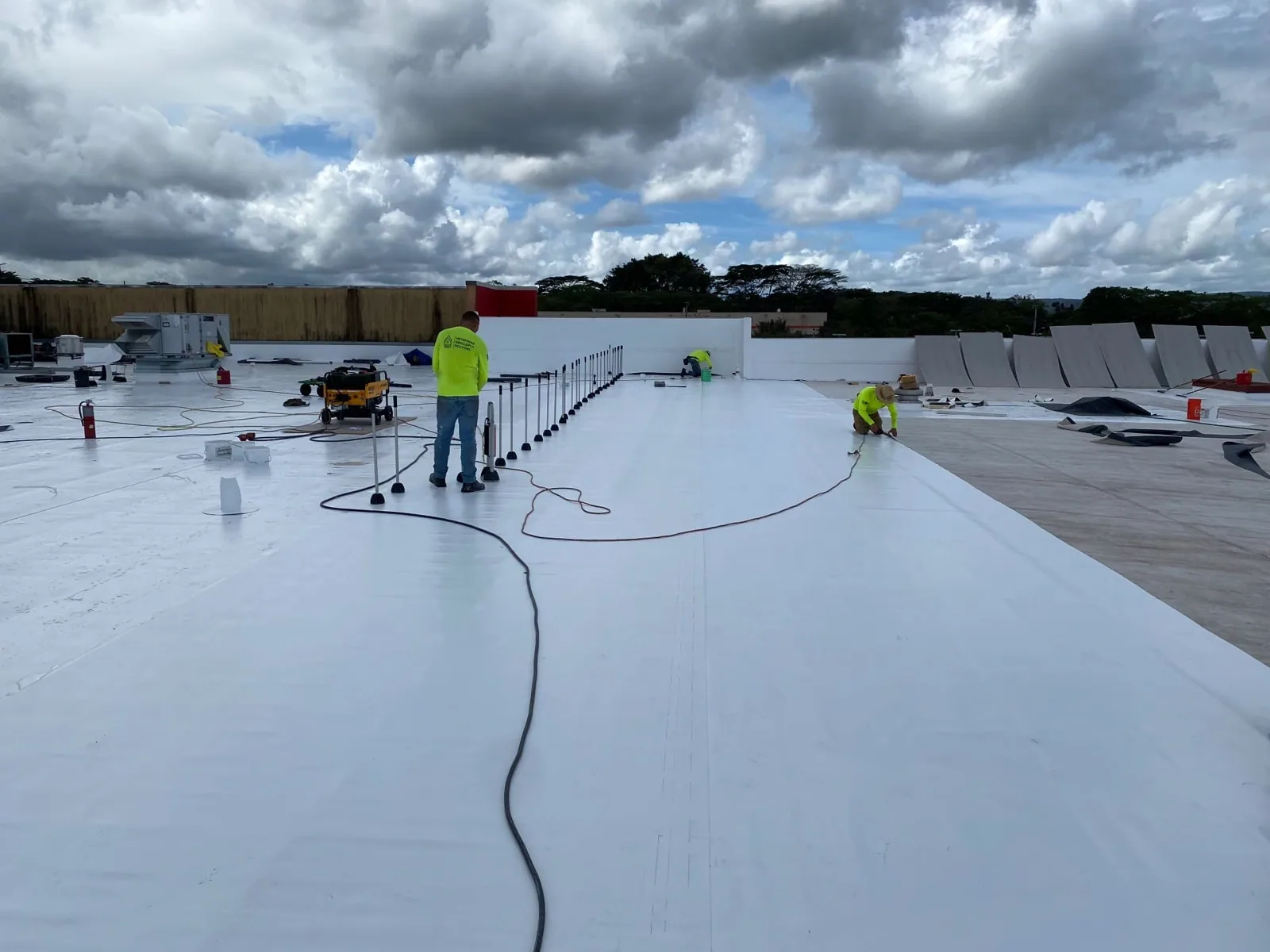
The first sign of a tired TPO roof is a seam that has gone shiny and loose. You find it on foot, not from the parking lot. After a few Texas summers a sheet that was bright white on day one turns chalky grey, and the welds carry more stress than they were built for. That is a budget conversation. It goes better in April than it does after a storm.
TPO is the single-ply membrane most low-slope owners in Greenville, TX end up pricing. Thermoplastic polyolefin comes in wide rolls, welds with hot air and reflects the sun. It suits long, flat roofs on warehouses, plants and strip centers. Here is how it behaves in this climate, what moves the price and when we would steer you to something else.
Why do so many Greenville owners land on TPO?
Because it fits the way big industrial buildings are roofed: long, flat and heavy with rooftop units. The Park West Industrial Park and the Shelby Avenue district include manufacturing properties. Compare reflective TPO with each roof’s area, insulation, drainage and project requirements. Welded seams make one continuous membrane instead of a patchwork of glued laps.
It also installs fast. Wide rolls mean fewer seams per acre of roof, and a crew can lay a lot of sheet in a good weather window. On a plant or warehouse where every roof day costs money, that speed shows up on the invoice.
The trade is quality across the product line. TPO is made by many mills, and the sheets are not all the same. We spec the membrane, the insulation and the fastening pattern together, not the sheet alone.
What does a hundred-degree summer do to a TPO sheet?
It ages it, slowly and from the top. Dallas-Fort Worth recorded 27 days of triple-digit heat in July 2022, and a flat roof runs well above air temperature on afternoons like those. Heat and UV work on the surface, the sheet gets stiffer, and the first place that shows it is the edge of every weld.
A roof baking over a blackened cover board or a wet insulation layer ages faster. So does a roof with a lot of ponding, because standing water holds heat and concentrates grit.
We look for crazing, chalking, and sheet that has pulled tight at walls and curbs. None of it is an emergency alone. Together it tells us how many seasons are left and whether to spend on repairs or plan the tear-off.
How are the seams made, and how do they let go?
A crew runs a hot-air welder along the lap, then rolls it down behind the nozzle. When the weld is clean, the two sheets fuse into one. When the surface is dirty, cold or rushed, the weld looks fine and fails in two years.
We probe every seam after welding. A thin screwdriver edge run along the lap finds a skipped spot before the roof ever sees rain. That check costs minutes and saves a callback.
Old seams fail by peeling at the edge, usually where the roof moves the most. Corners, drains and wall bases go first. A seam failure repair on a sound roof is a day of welding. On a roof with chalky, brittle sheet, it is a patch on a patch.
What does hail do to a TPO sheet in Greenville?
It bruises. North Texas spring storms throw hail up to softball size, and the June 2019 Greenville storm dropped baseball-sized hail and collapsed a downtown Lee Street roof. A TPO inspection should document the installed assembly and observed surface condition before any repair is priced.
The fix is built into the assembly. Dense cover board under the sheet gives hail something to bounce off, and a thicker membrane takes more punishment before it fractures. Neither makes a roof hail proof. Both buy time and keep the claim smaller.
After any storm we walk the field of the roof and press the sheet. Soft spots and fractures get marked and photographed, and that photo set is what goes to the adjuster after hail damage on a roof.
What does a TPO job cost and what moves the number?
The price follows the scope, not a flat rate per square. Roof size comes first, then how much old roof has to come off. A tear-off costs more than a recover over dry insulation. Insulation thickness, cover board, and the number of penetrations, curbs and wall details all push the figure up or down.
Access matters too. A roof with one ladder and no room to stage material takes longer than a roof next to an open dock. Occupied buildings add planning time for tenants and truck traffic.
You can often save by choosing a recover when the existing insulation is dry. A moisture survey tells you whether that is real or wishful. Spend on the survey first, then on the roof.
When is TPO the wrong call?
When grease, oils or harsh chemicals hit the roof every day. A food plant exhaust or a heavy-process building may fit PVC better. When foot traffic is constant and the roof is small and cut up with details, EPDM can be easier to detail and repair.
TPO also asks for a clean, dry deck and good drainage. Where water ponds deep and stays, we fix the slope or add drains before we lay a sheet that will sit in a pond for a week after every storm.
Not every roof needs a new sheet. A sound warehouse roof can often be saved with targeted repairs and a firm maintenance schedule. We tell you which is which. For a TPO portfolio in Commerce and Sulphur Springs, compare seam welds, edge securement and drainage from roof to roof before setting priorities.
Commercial Roofing Questions
How thick should the sheet be on a big warehouse roof?
Go thicker wherever people or equipment will be walking. Rooftop units mean service techs, and service techs mean foot traffic along the same paths for years. A heavier sheet takes that wear and hail impact better, and the extra material cost is small next to the cost of an early tear-off. On a quiet roof with few penetrations, a standard gauge is fine. We set the thickness after we see the roof plan and how the building is used.
Can new TPO be welded to an old TPO roof?
Only when the old sheet is still clean enough to fuse. TPO that has chalked and weathered for many summers often needs cleaning or a different repair method before a weld will take. We test a small area first. If the weld pulls apart, we fall back on mechanically fastened patches or cut out the failed section. Guessing wastes a day and puts the patch at risk, so we test.
How often should a TPO roof be looked at?
Twice a year, once after winter and once after storm season. A spring walk finds what the cold and the wind did, and a fall walk finds what the heat and the hail did. Add a visit after any severe storm. Most of what we find on those walks is cheap to fix, like a loose boot, a split corner or a drain with debris in it. Missed for a year, the same items turn into wet insulation.
Can TPO be installed over my existing roof?
Often, if the insulation under the old membrane is dry and the deck is sound. We confirm that with core cuts and a scan before anyone orders material. A recover saves tear-off labor and disposal, and it keeps the building dried in. It also adds weight and can raise the roof edge, so we check drains, curbs and the structure. If the old roof is wet, it comes off.
How does TPO pricing compare with PVC and EPDM?
In most markets TPO sits near the lower end of the single-ply range, with PVC priced higher and EPDM landing close to TPO depending on thickness and attachment. Those relationships shift with the supply chain, so we price your actual scope rather than quote a rule of thumb. Ask for the roof system and the details in writing, because a cheap sheet with thin insulation is rarely a good buy.