Infrared Roof Moisture Survey in Greenville, TX
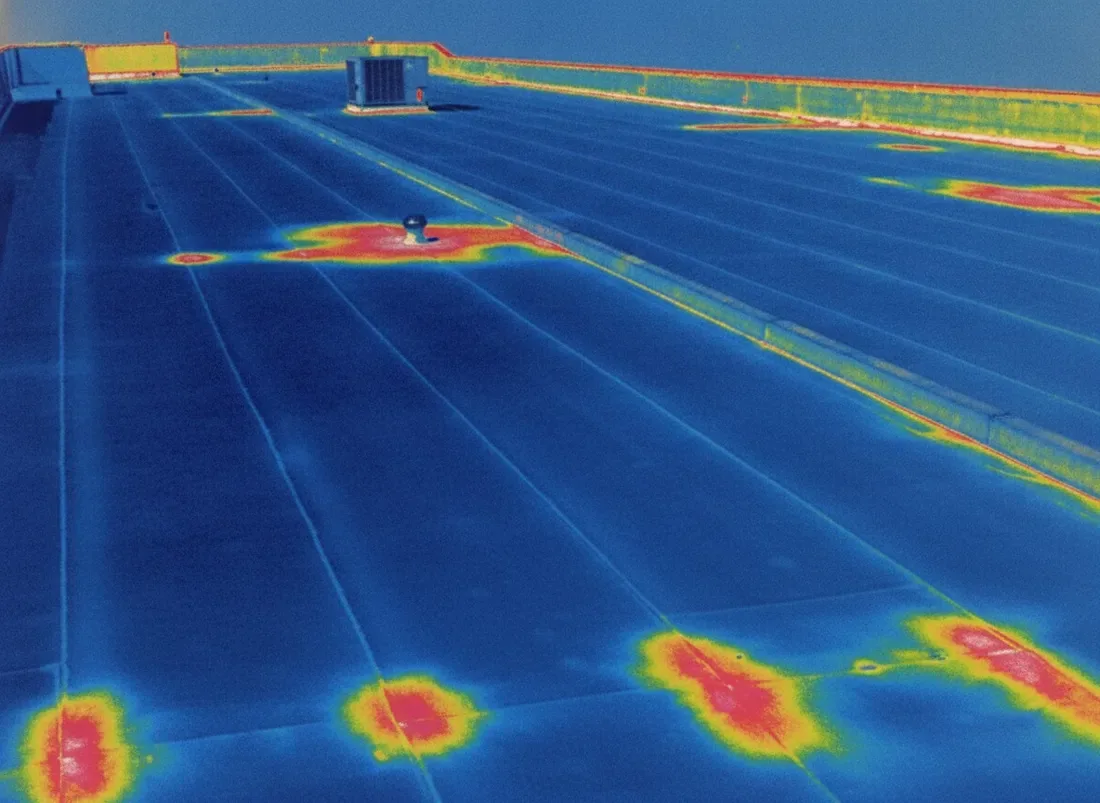
Wet insulation looks exactly like dry insulation from the top. Same membrane, same seams, same sun. The difference is underneath, and it decides whether your roof can be repaired, recovered or has to come off. A moisture survey shows you that difference before you commit the budget.
An infrared and core-cut moisture survey in Greenville, TX maps where water has gotten into the roof system and confirms it with samples. The result is a drawing with wet areas outlined and a number you can plan around. Most scope arguments end when that drawing hits the table.
How does an infrared scan find wet insulation?
Wet material holds heat longer than dry. After a hot sunny day, the roof soaks up warmth, and as the air cools in the evening, dry areas shed that heat faster. Wet insulation stays warm. An infrared camera sees the difference and draws it as a pattern.
So the work happens at dusk and after dark, on a roof that has had a full day of sun. We cross the roof with the camera, paint a mark on each warm patch and photograph it. Patterns often follow seams, drains and old leak paths, which helps us read what is going on.
The camera does not tell the whole story. Gravel, reflective surfaces, equipment shadows and different layers can fool it. That is why the scan is only half of the survey.
Why are core cuts part of the survey?
Because a picture of heat is not proof of water. We cut small test cores through the membrane and into the insulation at marked spots and at spots the scan calls dry. Then we check the material by touch, by moisture meter and by eye.
Cores answer questions the camera cannot. How many layers are there? What is the insulation made of? Is the deck rusting? Is the water new or old? Dry cores in a warm area tell us the scan overreached. Wet cores in a warm area confirm it.
Every core hole gets patched and sealed on the spot. We keep the count low and the repairs neat, since each hole is a small opening in an otherwise sound roof. When the work is done, the roof is as watertight as before, and you have data you did not have.
What do the results change?
They sort the roof into one of three decisions. If wet areas are small and isolated, you repair them, cut out the wet material and keep the roof. If the roof is mostly dry and sound, a recover over the existing roof may be an option. If wet insulation runs across large areas, the answer is a full replacement, and now you know why.
The survey also stops a common mistake. Owners spend repair money chasing leaks on a roof where the insulation is soaked, and the leaks just move. A leak repair over wet material rarely lasts.
And it protects you from the opposite mistake: tearing off a roof that still has life. Replacement is the biggest line in a roofing budget. You should not spend it on a guess.
What do I get when the survey is done?
You get a roof plan with every wet area outlined, a log of every core with photos and findings, and a clear read on how much of the roof is affected. Recommendations follow, written as scopes you can price: spot repair, partial replacement, recover or full tear-off.
The package drops into the rest of your records. It supports a roof condition report, a capital plan and an insurance conversation. If you are buying or lending on a building, it fits straight into a due diligence roof survey.
Keep the plan. Resurvey after a major storm or every few years and you can see whether wet areas have grown. Growth rate is the best predictor of how long the roof has left.
What does a survey cost and how long does it take?
Price follows roof size, the number of cores needed and how complex the roof is. A large, open roof is quick to scan. A roof with many levels, heavy equipment and a crowded surface takes longer and may need more cores.
Timing depends on weather more than anything. We need a clear, dry day with good sun, then calm, dry conditions in the evening. A wet roof or a cloudy stretch ruins the readings. So we schedule around the forecast and move the date if the weather turns.
The survey is a small cost next to the decision it informs. A tear-off that was not needed, or a repair that was wasted on wet insulation, costs many times more. We recommend running the survey before any replacement bid, so every bidder works from the same facts. A drone roof inspection can speed up the scan of a very large roof.
Why does North Texas weather make wet insulation common?
Hail opens the door. Spring thunderstorms in this part of Texas can drop hail as big as a softball, and a bruised or fractured membrane lets water in for months before anyone sees a stain. That is how insulation gets soaked under a roof that looks fine. Start with a hail damage repair review and then check what is under it.
Heat helps the survey. North Texas summers run long and very hot, and DFW saw 27 days of 100 degrees or more in July 2022 alone. A sun-baked roof stores plenty of warmth for the camera to read after dark.
Park West Industrial Park along SH 380 holds the 315,000 square foot Brakebush Brothers processing plant. Under a big plant roof, water can run a long way through the insulation before a stain shows inside. Hunt Regional Medical Center began a two-story expansion in 2021 for surgical and women’s services. A hospital roof requires a survey plan coordinated with facilities so inspection and any follow-up work respect current access and occupancy requirements. For buildings in Commerce and Sulphur Springs, pair each scan result with the roof plan and confirm suspect areas before any insulation is removed.
Commercial Roofing Questions
Do I need a moisture survey before I replace my roof?
We recommend it. The survey tells you how much insulation is wet and whether the roof is a repair, recover or tear-off candidate. Without it, bidders guess, and the guesses show up as change orders. It is a small cost compared with a replacement and keeps every bid on the same footing.
Will the core cuts damage my roof?
Not if they are patched right. Each core is small, and we seal and flash it the same day. We use as few cores as the roof needs to confirm the scan. Done right, the roof ends the survey as watertight as it started.
Does infrared work on every type of roof?
It works best on low-slope roofs with dark or exposed membranes, and less well on ballasted, gravel or highly reflective surfaces. Where the scan is limited, we lean harder on cores and meter readings. We tell you before we start whether the roof is a good candidate and how we plan to cover the gaps.
How long are the survey results good for?
They are a snapshot. Wet areas can grow with every rain, and a hail event can start new ones. For a roof in decent shape, plan a fresh look every few years and after any major storm. Comparing surveys over time shows which areas are spreading and which are stable.
Can a survey keep me from replacing a roof early?
Yes, and that is one of its best uses. If most of the insulation is dry and the membrane is sound, a repair program or recover can carry the roof for years. If not, you can plan the replacement on your timing instead of on an emergency. Either way, you decide with data.