Skylight and Penetration Flashing in Greenville, TX
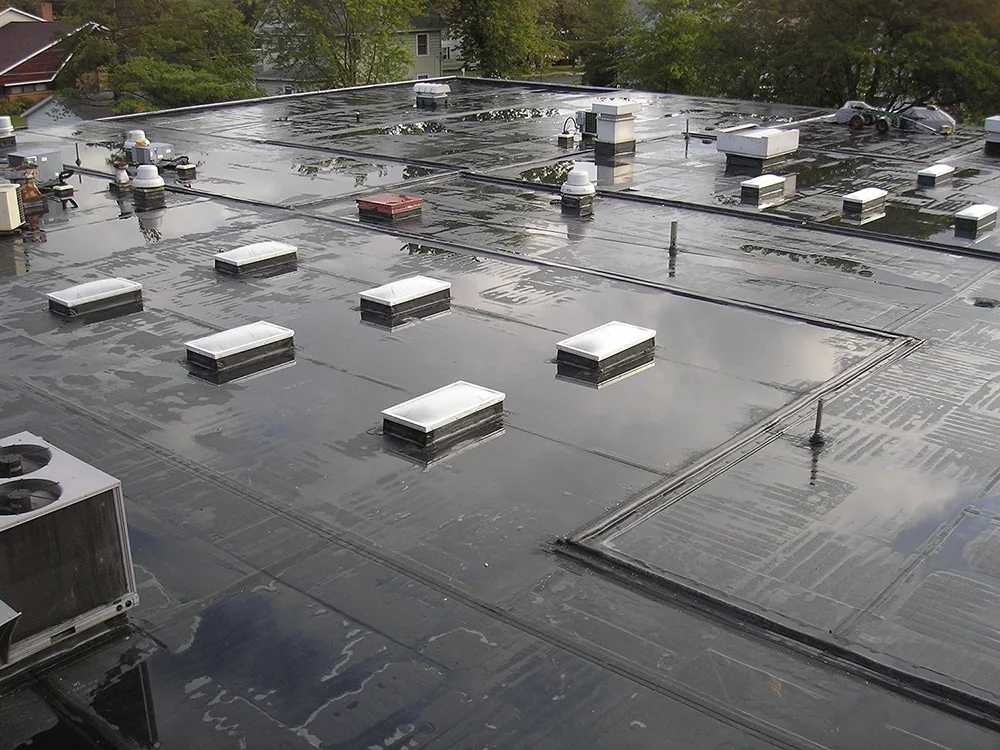
Black sealant cracked open around a pipe boot is the oldest leak on the roof. It is also the most common one. Every hole through a roof is a place where two materials meet and move at different rates, and that is where water gets in.
Skylights, curbs, vents, stacks and conduit all poke through the membrane. A big building can carry hundreds. In Greenville, TX we flash each one so it sheds water on its own, instead of leaning on a bead of caulk that will not last through a summer. That keeps the leak call from coming back every spring.
Why do penetrations leak more than the field of the roof?
Because they are joints, and joints move. A pipe is warm when the sun is on it and cool at night. The membrane around it moves differently. The bond between them is asked to stretch and recover thousands of times a year.
Sealant is the usual stopgap. It is fine as a backup and a poor primary defense. It dries, cracks and pulls loose in the heat, and it needs recoating on a schedule that nobody keeps. A proper flashing carries the water on its own and uses sealant only at the termination.
Foot traffic adds to it. Trades climbing around penetrations crack boots and bend flashing. We look at the walking paths as well as the penetrations. A leak repair that stops at the stain, without checking the nearest penetration, usually comes back.
What do you look for on a skylight?
The dome, the curb and the flashing that joins them.
Plastic domes yellow, craze and crack with age and sun. Hail makes it worse, because a dome that has taken stones can hold hairline cracks that open in the next heat cycle. Glazed units show seal failure, fogging between panes and rust in the frame. At the curb, we check the flashing corners, the counterflashing, the fasteners and the sealant at every lap.
Condensation is a separate problem that looks like a leak. Moisture forming on cold glass and dripping off the frame has nothing to do with the roof. We tell the two apart before anybody opens a ceiling.
Safety counts too. A skylight is a hole someone can fall through. Where the building has no guard screens or rails, we flag it, because a cracked dome is not a walking surface.
How do you flash a curb or a pipe the right way?
The curb has to be tall enough that standing water never reaches the top. The flashing runs up the curb, over the top edge and under a metal counterflashing that sheds water outward. Corners get formed or welded pieces, not folded patches.
Pipes and stacks get a boot or a flashing collar sized to the pipe and matched to the roof. On a TPO roof, that usually means a heat-welded boot that becomes part of the membrane. Pitch pockets, once common, fail over time as the filler shrinks, so we replace them with a better detail wherever the roof allows.
Larger equipment is a separate subject: units, platforms and pipe supports on rooftop equipment curbs and supports have their own demands. Each repair is tested and photographed before we move on.
Should we repair, rebuild or remove it?
Three routes, and the right one depends on the unit.
Re-flash it when the skylight is sound and only the flashing has failed. That is a short visit and a modest cost. Rebuild the curb when it is rotted, too short or poorly built. Replace the dome or the whole unit when it has aged out or been cracked by hail.
The third route is removal. Some buildings no longer need the daylight, and a skylight is the most leak-prone thing on the roof. Closing it with a new deck, insulation and membrane takes away a permanent risk. Owners who want to keep the light can choose a unit with better impact resistance than the original. Whatever the choice, put the cost of each route side by side and look at the leak history.
How long does the work take and who is in the building?
One pipe boot is a quick job. A skylight rebuild takes a day or two, with the crew working from the roof. A whole roof of penetrations is staged by section so the building is never open to the sky.
Interior protection comes first. We cover floors, racks and equipment under any opening and keep the work area clear. Dust and debris stay on the roof side.
Weather decides the order. Flashing needs a dry surface, and an open curb on a day with rain in the forecast is a bad bet. We stage material, open a few details at a time and dry each one in before the crew moves. That keeps tenants working while the roof gets fixed.
Where do Greenville buildings carry the most penetrations?
Hospitals and plants. Hospital roofs can include mechanical, exhaust and plumbing penetrations. At Hunt Regional Medical Center on Joe Ramsey Boulevard, coordinate roof access and work windows with the facilities contact. A leak in the wrong place is a patient care problem, not just a maintenance one. Hospital roofing in the I-30 and Joe Ramsey commercial corridor lets the clinical floor's schedule set the order of work.
Brakebush Brothers’ 315,000-square-foot processing facility is in Park West. At a processing facility, inspect every stack, exhaust fan and pipe penetration on the actual roof. East Texas A&M University is in Commerce. Inspect skylights, atrium glazing and other penetrations building by building before setting the scope.
All of it sits under North Texas hail. Greenville’s June 2019 storm brought baseball-sized hail. A skylight’s condition depends on its material, protection and observed damage; inspect it before assigning a repair scope. After a hail event we check the domes and curbs before anything else.
Commercial Roofing Questions
Can a leaking skylight be fixed, or does it need replacing?
Often it can be fixed. If the dome is sound and the leak is at the curb flashing, we re-flash it and the unit stays. If the dome is cracked, yellowed to the point of brittleness or the frame is rusted, replacement costs less than repeated repairs. We show you the failure and give both prices.
How do you stop a leak at a pipe without tearing up the roof?
We replace the boot or collar and rebuild the membrane tie-in around it. The work is local, usually a few feet around the pipe, and the rest of the roof stays untouched. The old sealant and failed rubber come off, and a new flashing goes on with a proper bond. It is a quick repair on most roofs.
Is sealant good enough around penetrations?
Sealant is a backup, not the main defense. It holds for a season or two and then cracks in the heat. Use it at terminations and where a flashing meets a hard surface. The flashing itself should be a membrane boot, formed metal or a welded detail that sheds water without any caulk.
Should we cover the skylights before a hailstorm?
You cannot cover them in time, and you should not try to get on a roof with a storm coming. The better move is prevention. Impact-resistant domes and protective screens take stones better than standard plastic. After the storm, have the domes and curbs checked, because hairline damage often leaks later.
Will the flashing work disturb the people inside?
Barely. The crew works on the roof, and the only interior work is protection under an opening. Skylight replacement is the loudest part, and we schedule it around quiet hours or sensitive rooms. Tell us what is below the roof and we plan the order of work to match.