Military Installation Roofing Near Greenville, TX
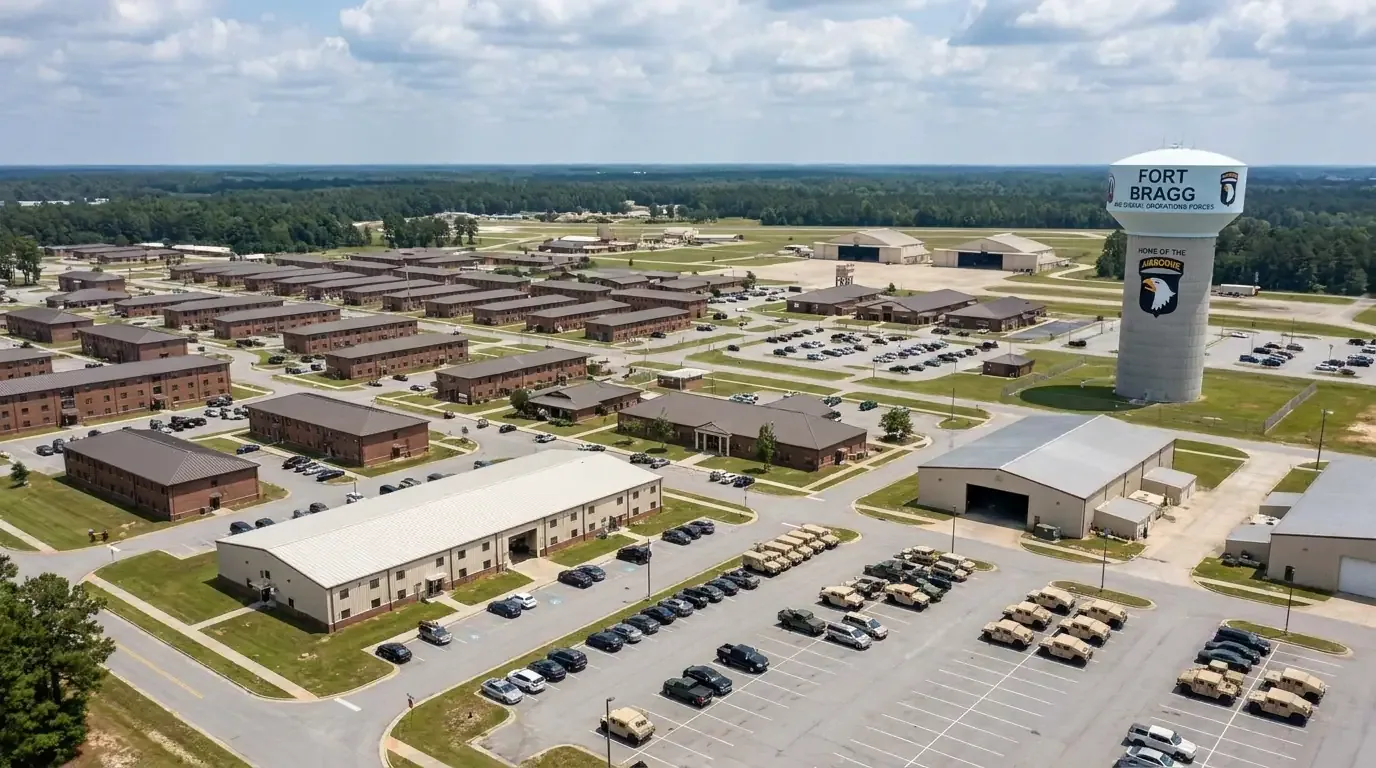
A stain on the ceiling over a vehicle bay does not wait for a gate pass to clear. The leak is on today's clock. The access paperwork runs on someone else's.
Roofing at a military or federal property near Greenville, TX requires a facility-specific access, delivery and work-window plan. Confirm requirements with the contracting officer before mobilization. Crews that ignore that schedule lose days at the gate. Crews that plan for it keep the dry-in on time.
Greenville has a National Guard armory, and Bonham has the Sam Rayburn VA campus. Confirm the owner, facility type and project requirements for each property. Government buildings are built to a spec, and the roof has to match it. We walk them with that in mind.
What does it take to get a crew on a base roof?
More lead time than a private job. Installations control who comes through the gate. Workers typically need a background check, a badge or a visitor pass and a named escort. Vehicles are inspected. Tool and material lists can be checked at entry.
Each site sets its own rules, and the contracting office or the facility manager passes them down. Some roofs are open to escorted crews during normal hours. Others sit inside secure areas where photos are restricted and phones stay in the truck.
We ask for the access rules in writing before pricing. Then we build the crew list early, because a badge request that starts late holds up mobilization. A crew that waits at the gate is paid, and so is the schedule slip.
What are the UFC roofing criteria and why do they matter?
The Unified Facilities Criteria are the Defense Department's design standards. For a military project, review the contract documents and applicable facility criteria with the contracting officer before selecting the roofing assembly.
For a roofer, that means the drawings and spec are not suggestions. Submittals get reviewed. Materials get checked against the spec. Confirm fastener patterns, flashing heights and other specified details against the project documents and current facility criteria.
We read the spec before bid day and ask questions early. We install to what the drawings call for, whether that is a single-ply membrane, a standing seam metal roof or a built-up system. If a detail is unclear, we get it resolved in writing before the crew starts.
How do mission schedules change the plan?
The building belongs to the mission first and the roofer second. Drill weekends, deployments, inspections and training days can block access with little warning. We plan work around those dates and keep slack in the schedule for them.
Quiet hours matter, too. Tear-off on a roof over an operations room or a barracks wing has to be planned with the people inside. Some work moves to off-hours. Some moves to times when the unit is away. Either way, the crew lead and the facility contact agree before the first fastener goes in.
Weather adds its own limit. A roof opened for a bay or a drill hall has to be dried in at the close of each shift, because the escort leaves when the shift does. We phase the work so the open area is small, as we would on an occupied building reroof.
What does base work cost beyond the roof?
Time, mostly. Escort hours, gate delays, delivery inspections and limited work windows add days that a private job would not have. Those days show up in the price as supervision, mobilization and standby, not as a mystery markup.
Four items move the number. The distance from the gate to the roof. How many workers need badges. How often materials must be inspected. And how many days the escort and the weather both cooperate. Roofs in secure areas cost more per square than roofs near an outer gate.
We separate those costs from the roof work on the bid, so the contracting officer or the facility lead can see what is roof and what is access. A commercial roof inspection before bid day gives you condition facts to price against.
Which military and VA roofs sit near Greenville?
Inside Greenville, the Texas Army National Guard armory sits on Jack Finney Boulevard near the Hunt County Fairgrounds and L3Harris. Armories typically have drill halls, vehicle and equipment bays and offices, so a walk of a National Guard armory roof starts by finding out what sits over each part of the building.
About 35 miles north, the Sam Rayburn Memorial Veterans Center in Bonham is a 78-acre VA campus with roughly 500 staff and around-the-clock nursing and rehabilitation. Work on a care campus like that has to protect patients and keep systems running, so a VA medical center roof is phased like an occupied building.
Majors Field began as an Army Air Forces training field in 1942 and is now a city-owned airport with L3Harris Mission Integration Division as its primary tenant. Roof work there starts with the same question as any other site: who controls access to the roof, and when.
What do North Texas storms do to government roofs?
The same storms that hit private buildings hit these. In June 2019, a storm pushed straight-line winds near 85 mph and baseball-sized hail across Greenville. In April 2014, an EF1 tornado east of Merit tore part of the metal roof and wall panels off a structure near FM 1569 and FM 903.
After a severe-weather report, inspect the property and document roof damage before assigning scope. Edge metal lifts, panels peel, membrane bruises. After a storm, the first step is a walk, with photos and a condition report the facility manager can forward up the chain. The first step on tornado damage roof repair is the same walk.
Public owners also have budget cycles, and public agencies that know what a roof needs before the next fiscal year get the request in on time.
Commercial Roofing Questions
How long does base access take to arrange?
Plan for weeks, not days, and start as soon as the award is in sight. Each site has its own process for background checks, badges and escort scheduling. We ask for the workers' list and the required forms on day one, and we keep a backup crew member badged in case someone is out. A late badge request is a common reason a base job starts late.
Do you need an escort the whole time we work?
On most installations, yes, at least in secure or controlled areas. The escort has to be on site whenever the crew is, so our schedule follows the escort's availability. That means shorter working windows and some standby time. We bring that into the price, and we ask the facility contact how many escorts are available before we set the crew size.
What is the difference between UFC criteria and a regular roofing spec?
Standard commercial specs are written by the owner or designer. The UFC roofing criteria are a Defense Department baseline that designers on military projects start from. They cover system types, insulation, drainage, wind uplift and details in a structured way. The spec on your drawings may add to them. We follow the drawings, and we flag anything that conflicts.
Can roofing work on an armory happen during drill weekends?
Usually not on the roof directly over a building in use. Drill weekends bring people, vehicles and noise-sensitive training. We plan the loud tear-off for weekdays when the building is quiet and schedule dry-in and clean-up before units arrive. Your facility contact sets the calendar, and we keep slack in it for changes.
Are VA campus roofs handled differently from other buildings?
In one major way: patients. A nursing or rehabilitation building runs around the clock, so noise, dust, odors and air intakes get extra attention, and work is phased in small areas. Infection control rules may apply near clinical spaces. We coordinate with the facility team on each phase and treat the job as an occupied reroof with stricter protection.