Standing Seam Metal Roofing in Greenville, TX
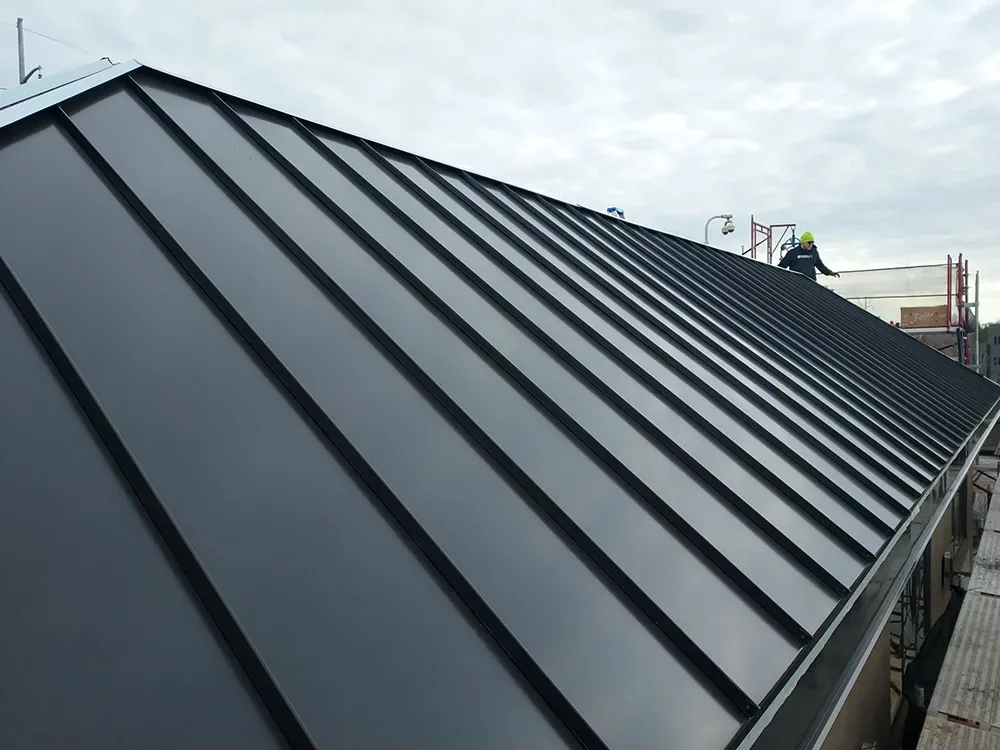
Oil canning shows up in low sun, as shallow waves rolling across a flat metal panel. Most owners notice it at four in the afternoon and call us worried. It is usually cosmetic. What matters is what is going on at the seams and clips, where a standing seam roof either does its job or starts to leak.
Standing seam is a metal roof with raised seams that run from eave to ridge and hide the fasteners underneath. Standing seam can serve a range of sloped or wide-span buildings; confirm the structure, slope, drainage and attachment before specifying it. The repair scope turns on clip movement, seam condition and how each panel terminates at the edges.
What makes standing seam different from a screwed-down metal roof?
The fasteners. A screwed-down panel is held by screws that go straight through the metal, each one a hole sealed with a rubber washer. A standing seam panel is held by clips that tuck under the seam, so nothing pierces the weather surface. The seams lock together and shed water from above.
That design fixes the main weakness of exposed-fastener roofs. Washers dry out and screws back out, and every one is a place for a leak. With concealed clips, there are far fewer openings in the field of the roof.
Panels are formed to length, often on the job, so they run unbroken from the ridge to the eave. Fewer end laps mean fewer leak paths, and the steep slope sheds rain fast. Details at penetrations, curbs and edges still need good flashing, and that is where we spend our time.
How do clips handle heat and thermal movement?
They let the panel slide. Metal grows in afternoon heat and shrinks at night, and a long panel moves a surprising distance. Floating clips hold the panel to the deck while allowing that movement, so the metal does not fight its own fasteners.
When clips are the wrong type or are set too tight, the panel binds. You hear it pop or tick as the sun moves, and over time a stressed seam can open. Fixed clips are used near the ridge or midpoint to hold the panel in place, and floating ones carry the rest.
We look at this on every standing seam roof. Sun-baked Greenville summers put a lot of movement through every seam, and a month like July 2022, with 27 triple-digit days across DFW, tests all of it.
What do we check on an existing standing seam roof?
We start at the seams and the clips. Open or popped seams, backed-out clip screws and failed seam sealant show up first. Penetrations come next: vents, curbs, skylights and rooftop equipment all need boots or flashings that move with the metal.
Then the panels. We look for dents, scuffs that have cracked the finish, rust at cut edges and fasteners at the eave and rake trim. Finish damage matters because bare metal oxidizes.
Drainage is the last stop. Gutters, downspouts and valleys have to move water off, and leaves and debris collect fast in a valley that nobody cleans. We write up everything with photos, and if the roof needs a bigger fix, we show you where. An older screwed-down roof that fails these checks is a candidate for a metal roof retrofit.
How does a standing seam roof take wind, tornado and hail?
Wind is the test. Standing seam is rated for uplift as an assembly, so the panels, clips, deck and attachment all count. An EF1 tornado with winds near 105 mph struck east of Merit in April 2014 and partially removed the metal roof and wall panels from a structure near FM 1569 and FM 903. Greenville’s June 2019 storm produced straight-line winds near 85 mph; inspect each roof after a wind event. Edges, eaves and ridges take the worst of it.
Hail can dent metal panels; inspect the finish, seams and attachment to determine whether repairs are needed. Most dents are cosmetic, and insurance policies treat cosmetic damage differently, so read yours before a storm. We document each dent and any seam or finish damage for the adjuster. After a bad one, tornado damage roof repair starts with a dry-in.
Hail on standing seam matters most when it cracks the finish or opens a seam. That is the fix we scope.
What does standing seam cost and how long does the install take?
Price follows the scope: roof area, panel gauge, finish, trim and flashing, the number of penetrations and how hard the roof is to reach. A simple rectangle with long panels costs less per square than a cut-up roof with hips, valleys and curbs. Panel gauge and coating change the number as well.
Panels are often formed on site, which saves shipping long lengths and lets the crew match the roof. Install runs fast once the deck is ready, but the weather window still matters, because panels are lifted and set by hand in light wind only.
A tear-off, if there is one, adds days. A retrofit over the existing roof is quicker and keeps tenants dry. We put both numbers side by side and tell you what moves each one.
Where does standing seam belong in Greenville?
Where the building is big, the roof is steep or the owner wants a long service life. For an aircraft hangar, check the frame, slope, drainage and attachment before specifying standing seam. L3Harris performs aircraft modification work at city-owned Majors Field, beside the Greenville Business Air Park. Aviation use alone does not establish the roof assembly.
Churches and schools use it for its look and its drainage. On Joe Ramsey Boulevard, a church sanctuary’s roof sustained extensive damage in the 2019 storm. After a local weather event, document the condition of each roof assembly before repair. The National Guard armory on Jack Finney Boulevard is the kind of institutional building where roof type, access and schedule get planned up front.
Flat warehouse roofs are usually better served by a membrane such as TPO. Standing seam needs slope. For metal roofs in Commerce and Bonham, inspect clips and panel movement at each building before carrying a repair detail into a second project.
Commercial Roofing Questions
Does a standing seam roof need maintenance?
Less than most roofs, but not none. Twice a year we walk it, check seams and clips, look at penetrations and clear the gutters and valleys. Failed sealant and loose trim are the common finds, and they are cheap to fix on a visit. Skip that routine for a few years and small items can turn into water at a curb or a wall.
Can standing seam go over my old roof?
A retrofit framing system makes it possible on many buildings. Sub-purlins or a support grid go over the old roof, and new panels clip to them. That avoids a tear-off and keeps the building dry. We check the structure and the old roof first, then price it next to a full replacement. It is the same logic as a metal roof retrofit on an existing screwed-down roof.
Will hail dents hurt my roof or only the looks?
Most dents are cosmetic. The panel still sheds water and the seams still lock. What matters is whether hail cracked the paint finish, opened a seam or bent a clip. We check those first and document the rest for your adjuster. Whether cosmetic damage is covered depends on the policy, so read your terms before the next storm.
Why does my metal roof pop and tick in the afternoon?
That is thermal movement. Metal expands in the heat and slides on its clips, and the popping is panels shifting against trim or clips. A little noise is normal. Loud bangs, or noise paired with open seams, point to clips set too tight or the wrong type. We check clip type and spacing and fix it before the seams fatigue.
Is standing seam worth the cost over a TPO roof?
Weigh it against the life of the building. Standing seam usually costs more up front, and it can last longer with less recoating or resealing. A membrane costs less and works on low slopes, but needs closer attention to seams and flashings. On a pitched or hangar-style roof, metal is the natural fit. On a flat roof, we price both and tell you what we see.